Monday, 8 February 2021

February

GOLD!


Gold is a chemical element with the symbol Au (from latin: aurum).  In a pure form, it is a bright, slightly reddish yellow, dense, soft, malleable and ductile metal. It is one of the least reactive chemical elements and is solid under standard conditions.  Gold often occurs in free elemental form, as nuggets or grains, in rocks, in veins and in alluvial deposits.

The oldest known map of a gold mine was drawn in the 19th dynasty of Ancient Egypt (1320-1200BC), whereas the first written reference to gold was recorded in the 12th Dynasty around 1900 BC.


A relatively rare element, gold is a precious metal that has been used for coinage, jewelry and other arts throughout recorded history.  In the past, a gold standard was often implemented as a monetary policy, but gold coins ceased to be minted as a circulating currency in the 1930s and the world gold standard was abandoned for a fiat currency system after 1971.


A total of 197,576 tonnes of gold exists above ground, as of 2019.  This is equal to a cube with each side measuring roughly 21.7 metres. Gold''s high malleability, ductility, resistance to corrosion and most other chemical reactions, and conductivity to electricity have led to its continued use in corrosion resistant electrical connector in all types of computerized devices(its chief industrial use).  Gold is also used in infrared shielding, coloured-glass production, gold leafing and tooth restoration. Certain gold salts are still used as anti-inflammatories in medicine.  As of 2017, the world's largest gold producer by far was China with 440 tonnes per year.

Because gold is the most malleable of all metals a single gram can be beaten into a sheet of 1 square metre!  Gold does not react with oxygen at any temperature and, up to 100 degrees C, is resistant to attack from ozone.  Gold readily dissolves in mercury at room temperature to form an amalgam, and forms alloys with many other metals at higher temperatures. These alloys can be produced to modify the hardness and other metallurgical properties, to control melting point or to create exotic colours.

Medicinal applications of gold and its complexes have a long history dating back thousands of years. Several gold complexes have been applied to treat rheumatoid arthritis.  Gold compounds have been investigated as possible anti-cancer drugs.

Gold has been used since ancient times to create figurines, coins, crowns and for religious purposes.  It also played a role in western culture, as a cause for desire and of corruption, as told in children's fables such as Rumpelstiltskin, where he tuns hay into gold for the peasant's daughter in return for her child when she becomes a princess, and the stealing of the hen that lays golden eggs in Jack and the Beanstalk. The top prize at the Olympic Games and many other sports competitions is the gold medal.  Many buildings are covered with an ultra-thin layer of gold i.e. The Sikh Golden Temple, the Harmandir Sahib, in Amritsar, India.


Gold can be used in food.  Gold leaf, flake or dust is used on and in some gourmet foods, notable sweets and drinks as a decorative ingredient.  Danziger Goldwasser or Goldschlager is a traditional German herbal liqueur (very good) which contains flakes of gold leaf.
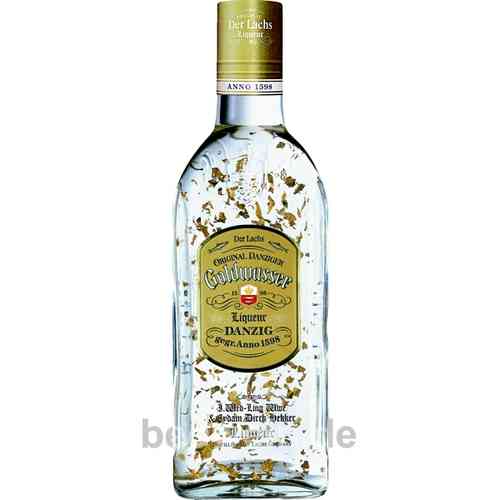


Gold can be manufactured so thin that it appears semi-transparent. It is used in some aircraft cockpit windows for de-icing or anti-icing by passing electricity through it.  The heat produced by the resistance of the gold is enough to prevent ice from forming.

Cloth of Gold or gold cloth is a fabric woven with a gold-wrapped or spun weft referred to as "a spirally sun gold strip".  In most cases, the core yarn is silk wrapped with a band or strip of high content gold.  It has been popular for ecclesiastical use for many centuries.  Under Henry VII of England, its use was reserved for royalty and higher levels of nobility.  It is also used today by companies such as Charvet for neckwear.  Producers of cloth of gold include the Byzantine Empire and Medieval Italian weavers, particularly in Genoa, Venice and Lucca. A similar cloth of silver was also made.  Most modern metallic fabrics made in the West are known as lame.

Cloth of Gold is still being manufactured in Venice by Tessitura Luigi Bevilacqua (www.luigi-bevilacqua.com).  The gold cloth is a luxury fabric for furnishing and clothing (very heavy), made by interlacing silk and golden or silver threads.  In 2012 they made a dress for Dolce & Gabbana which also included Bevilacqua's Italian velvet.


Books mentioned at the Zoom meeting Tuesday Feb. 9


Jeanette

'I have chosen Birds as my theme for the accordion book.  I will chose a different coloured bird for each page.  I haven't decided yet how many pages I will create but I am hoping I will know when I am done.  I chose Red for my first page and the bird featured is a Red Macaw.'


Linda

Linda is keeping busy and warm I hope!  Here are some of her art cards.  


Just in time for Valentine's Day!


Cathy


These are my two gold pages.  I started out doing my art signature using gold embroidery thread, but ran out of thread.  Just as well because it was terrible to work with, switched to lame and beads.  The second page is the Golden Ratio.


The guild suggested online quilt classes, and I signed up for Lyric Kinard's class Playful Portraiture.  Did not like any of her portrait choices, so selected one off the internet of this lovely interesting lady.


Elisabeth


Wednesday, 13 January 2021

January 2021

Zoom meeting!


It was so lovely to see faces again and have a chance to chat and show work.  We will have another Zoom meeting next month as well.  Hope everyone can make it.


Brigitte was presenting for us this month and she has chosen:


Weaving as a way to create texture


There are many ways to add texture to your textile art: both visual and tactile.  One tactile method is incorporate weaving.  Weaving can be done with strips of fabric, lace, ribbon, Tyvek, raffia, and of course yarn of various thicknesses.  You can work in a single colour and its various tints and shades, a complimentary colour scheme or colours usually associated with a specific culture, eg. Tribal.


Let's try to incorporate some weaving in our project this year.


What you need:


           Various strips of fabric, ribbons, lace, braiding

           Paper backed fusible such as Steam-A-Seam or Wonder Under

           Backing fabric

           Optional: Netting


Cut the backing fabric to the size that you want your finished weaving to be.  I chose several sizes ranging from 8 x 10 to 4 x 6.


Apply paper backed fusible to the background fabric.


Working from left to right, with fusible side facing up, line the fabric strips vertically along the top of the background fabric until covered and pin in place.  These strips act as the warp.


Starting horizontally at the first row, weave a fabric strip over and under to create the first weft row.  Pin in place.


Continue till the background fabric is covered.


Finish by pressing the weave to the background fabric to stabilize and hold everything in place.  Now how about adding some stitching?  I'll challenge you to pick some fancy stitches from your machine to add to your weaving, or if you are a hand stitcher, some fancy embroidery.


This is a plain weave.  By changing the way the weft strips are woven you can create patterning as well.


For example this is  twill weave pattern.


Jeanette

Eucalyptus Deglupta is the third (and maybe last) picture in my "colours in the natural world" series. It is also known as the Rainbow Eucalyptus. It is native to the Philippines, Indonesia and Papua New Guinea.
  
It has smooth, orange-tinted bark that sheds in strips, revealing streaks of pale green, red, orange, grey and purplish brown. I took artistic license and added some other colours in my picture. 

Please look it up online. It is really amazing.


Cathy

So weavings....tried working with wool, and it was just too thick to work properly within the accordion book.  So that lead to working with fabric strips and the end result of 'peach weevils', followed by the use of embroidery thread to create rock weavings.


Cath

I had the good luck to find a piece of fabric I had already woven and hadn't used.  I cut out flower petals and then added a black rose bead to the centre of one.  Just have to reuse things when you can!


Judith


I tried weaving with fusible ribbons but they were too flimsy to work.  So I cut 1/4 strips and wove those.   


They look good, Judith.  Interesting to see where you go from here.


Elisabeth sent pictures of what has been keeping her busy this winter!


                                                              Christmas cards


                                      Cloth bags for the Community Arts Centre sale


                                             Diving for Cover  - a sun printed fish


                                                    Pages for the accordion book


Monday, 7 December 2020

December 2020

Yellow!


Judith is presenting Yellow this month.  She was going to start with a Joltz,  handing out a yellow post-it note and having you write down all the names for yellow you can in 30 seconds and then sharing.

Here is a bit of help.


Yellow is a primary colour but why is it the first seen by the human eye?

Apparently it is that the sensitivity of our eyes is at its peak when it perceives the wavelengths that we see as yellow.  Some say that it evolved as a way to help discern the fruit from the leaves on a tree.

So: This is why taxis are yellow, pencils are yellow, post-it notes and the original highlighter are yellow, caution signs are yellow and the first emoji, the smiley face, is yellow!

Cultural Uses and Beliefs

In China, the colour yellow was reserved for emperors, with less pure shades being given to royal relatives.

Ancient Muslims used it for less royal reasons; they tagged Jews and Christians with yellow badges.

In 13th Century England the Jews wore yellow patches.

1930s Nazi's tagged Jews with yellow stars.

Currently in Afghanistan the Taliban tags Hindu's.

Lamas of high levels wear yellow hats.

Zen equates yellow with wealth, health, knowledge and wisdom.

Aboriginals of Australia considered yellow to be important because it symbolized the sun and the creator.

Yellow is the colour of illness, especially jaundice.

In ancient Greece, blonds were prostitutes and bleached their hair.

Yellow rooms can increase focus for many.  Too much yellow causes stress.


Consider these uses:

Yellow-bellied, mellow yellow, yellow journalism, yellow peril (associated with the influx of Chinese immigrants), the golden ages, golden girls, golden handshakes, gold medals.   Some are positive and many are not, reflecting the many and various opinions about the colour.  

Oscar Wilde was imprisoned because he was seen carrying a Yellow pamphlet, seen to be a sign of dissidence, pornography and avant-garde thinking.  Yellow was the colour of those thinkers going against the norms of the day.


Dyes

Yellow dye that didn't discolour of fade was hard to come by.  The two early pigments, orpiment and gamboge were both very poisonous.  Naples yellow was sulphurous, India yellow was made (some say) from cow urine.  Lead-tin yellow, used from 1300-1750, suddenly went out of favour and wasn't rediscovered until the 1940s, with the help of modern chemistry.

And so, think of yellow differently when you see it next!  Enjoy!


PS

And (drum roll, please) Pantone's colour of the year is Illuminating Yellow and Ultimate Gray.


Cathy

Thank you for the yellow presentation.  Such a great colour to study on these grey days!


My first picture is my yellow pages created using the confetti technique incorporating many hand dyed fabric with free motion writing.


The yellow spectrum includes paint chips with great names.  My favourite is Fuzzy Duckling.

What is yours?


Friday, 13 November 2020

November 2020

 A snow day cancelled our meeting at Gallery Vertigo.  Winter is here.

We will continue to create but more from our homes.  We are looking into ways to stay in touch through online group chats.  Stay tuned as we try to sort this out.

Show and Tell

Joyce sent in three lovely pictures of what she has been playing with.

Rust dyeing


And another one based on Cathy's presentation of Colour Your World 


And finally rubbings that Joyce dyed at home.   


Christine has used some of her hand dyed fabric and the embroidery stitches on her machine for her work inspired by the Rainbow Mountain in China.


Cathy sent in pictures of her works of art, she has been very productive!  She is doing two pages for each technique so the accordion book will have a front and a back side. 

Starting with her interpretation of Colour My World. 


Cathy then did a paint pour on canvas and did not like the result.  She removed the canvas from the frame and cut out two pages.  She will spray shellac on the art so the paint does not flake.


The rubbings were a lot of fun and since we did not have our meeting Cathy tea dyed hers at home with rooibos for one and turmeric ginger tea for the other.


Next we have sun prints on coffee dyed fabric and some great results from the rust dyeing.


Cathy says she was inspired by the gallery X and O challenge.  In the middle of the night she thought about her world coin collection and thought they would work well for rubbings.  They were done with all the blue and orange crayons purchased at Staples.  She has done 12 blocks!


Cathy is interested in feedback on what people are choosing as a base for their pages if they are doing an accordion book.  She has quarter inch foam board but thinks that might be too thick for 12 to 15 pages.


Jeanette says she loved Cathy's idea of mounting pieces on little canvasses so ran out and bought a pack at Scattered Goods.

After thinking about Colour My World she remembered the awesome colours she had seen at the Aberdeen Columns.  If you haven't heard of them then you are in for a treat!  To find the columns you drive south into the forest behind Lavington, follow several logging roads and eventually, if you are very observant, you will find a tiny sign dangling off a tree indicating the trail head.  The columns are  only a 5 minute black fly infested walk from there.  She has included the photograph of the actual columns as well.


Jeanette has decided to fill the 4 canvasses with mini quilts showing colours found in the natural world that you wouldn't expect to see and are a pleasant surprise when you do come upon them.  She chose the red sandy beaches of PEI for her second piece.  Did you know they actually dye T-shirts with the sand?  These are available to be bought throughout PEI.


Thanks for the inspiration Cathy!


Cathy has done more!

Creating a fabric accordion book is all new to me. I did a two page mock up book so that I could experiment with different options. Have chosen to go with Pellon stabilizer as a base and did Fagoting stitch to join each of the pages. This allows for additional pages to be added at whim. Once the front and back art pages are completed, and quilted onto batting, they are clipped onto the Pellon and machine stitched. Tried finishing the edges with ribbon or decorative stitching but preferred the raw edge effect. a closure is made with a handmade button and wool.
It will be so interesting to see the variations in all the other members creations.

Thank you for all your input, instructions and encouragement.


Front pages


Back pages


Cath

I considered what to do for Colour Your World and thought about how some countries are well known for their colours.  Some times the colours relate to areas like the magical blue/green of Kalamalka Lake,  or the architechture of sunny Greece.  The national colours are often on the flags of the countries.  When I think of Canada the red and white of our flag always comes to mind.

Since I am using folded flowers instead of a book page here are my Canada flower and a bonus poinsettia for the holiday season.


March 2026

 "Creativity is intelligence having fun."  Albert Einstein The Orchard Valley Quilters Guild is having a display at the Rotary Ce...