Showing posts with label fabric. Show all posts

Sunday, 15 April 2018

Studying Texture and Encrusting

It's been a while since we have had additional information to post.  This past meeting, we enjoyed a stimulating creative exercise called " 30 circles" derived from UK Ed Chat.

We also began our study of texture and encrusting as it relates to visual art.  Mary, Elizabeth and Kay entertained us with information about the topic and provided a number of samples.  Here is what they discovered.

There are two styles of texture; visual and tactile.  So what does that mean in relation to our fibre art?

Tactile:  Is the fabric smooth like silk, or ribbed like corduroy?  This  can also include the weave of the fabric, the beading on it, or the stitching and any dimensional additions. 

Visual:  There is no actual texture on the surface, but rather gives the appearance of texture where no difference to the surface can be felt; e.g. a fabric printed with bark, droplets of water, or cracked concrete.

Here are some samples that Mary, Elizabeth and Kay produced for our group.  In this picture you can see the various different fabric textures that were used to create a tactile surface.


The postcard here has been stitched with fabric that has then been cut to create a chenille effect.

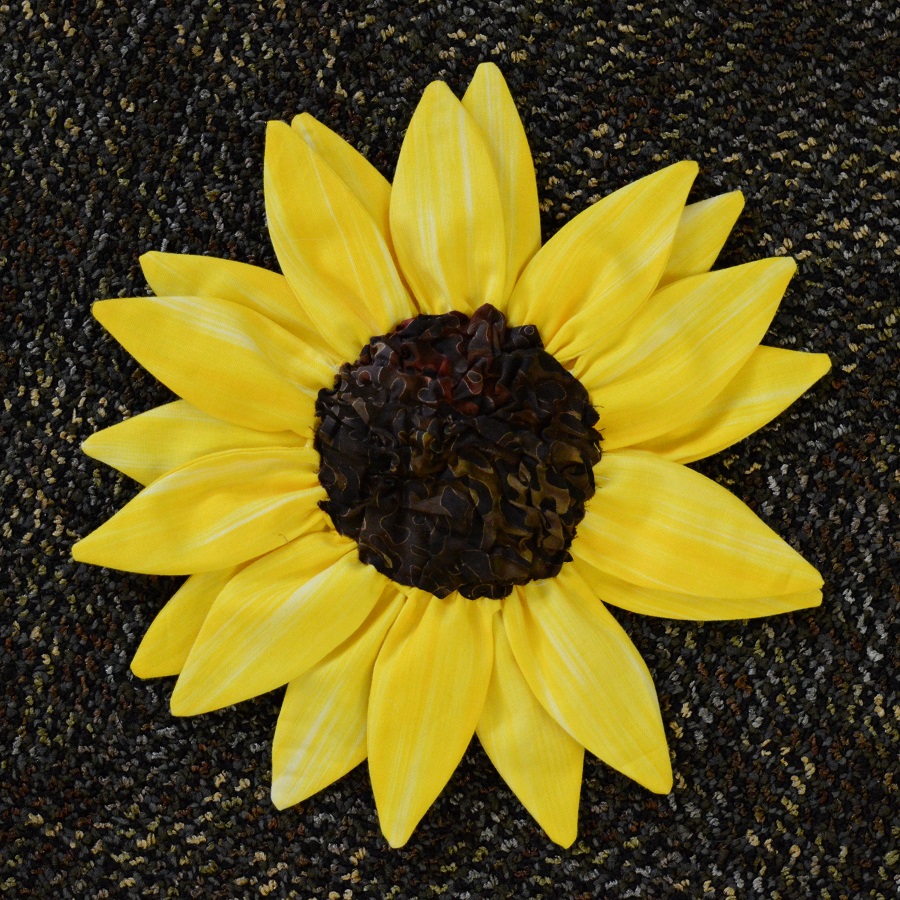
Another example showed the use of fabric texture created with a cooling rack to achieve a "nubbly" effect, which is used in the centre of the sunflower.  Texture Magic is a product that will also produce this effect.


In this example the horns of the figure are couched and the background is raw edge fabric stitched in place to create texture.

Consider using your twin needle to create texture as shown in this example.  Notice the ridges created by the stitching of the twin needle

Cathy provided an example of encrusting, another form of creating texture in our fibre art.  If an object is encrusted it is covered or overlaid with a coating or hard covering.  In our case, those coverings can include cheesecloth, cotton, organdy, organza, netting, or tulle.

On close inspection you can see buttons encrusted between fabric and stitched in place; cheesecloth encrusts additional little pieces.
A detail of the encrusted piece.
Ann Johnston in her book The Quilter's Book of Design writes; "Quilters have the advantage of being able to choose from a whole range of fabrics, embellishments, and quilting and construction techniques to achieve a wide variety of textures.  A hundred years ago quilters were taking advantage of fancy fabrics, embroidery stitches, paint, lace and ribbons.  We have even more options today."

Consider how couching, buttons, and puff paint might add to the texture of your textile piece.

Till the next time, happy stitching and creating.

Wednesday, 22 March 2017

Piece "D" - Painting on Fabric


Fabric Painting


Why Paint on Fabric?

A.      Why Paint

a.       Self expression

b.      Another layer in fibre art

c.       Create colour combinations that are precisely what you need

d.      Puts visual texture exactly where you want it.

e.      Can use it for shading

f.        Convenient compared to dye

B.      Why fabric

a.       Express differently than on paper of canvas

b.      Can sew fabric afterwards

c.       Becomes washable with proper treatment i.e. heat setting

d.      Can stand alone or use for background or cut in pieces

C.      “Negatives” compared to dye

a.       Doesn’t bond to fabric the way dyes do

b.      Can end up rubbing off

c.       Can create sewing problems

d.      Can turn hard on the surface

e.      Need a fabric medium to create a bond (either already in at the manufacturer or added later.)

Applying the Paint

A.      Equipment

a.       Spread with brushes, foam, sponges, trowels, putty knives, spatulas, pencils, fingers, squeeze bottles

b.      Spray with airbrush, spray bottles

c.       Splatter, splash, dribble, flicker with toothbrush, brushes, squeeze bottle

d.      Monoprinting with gels, glass or plastic

e.      Stamping with stamps, foam, sponges, kitchen or office objects, leaves, etc

f.        Screen for screen-printing

B.      Resists

a.       Wax, stencils, packing tape, glue, painters tape, salt, flour, corn starch, oatmeal, rice

b.      Sun printing

Paint Brands

Different brands have different levels of colour saturation, different consistencies, different viscosity, and different adherence to the fabric. See Chart

Some require formatting for fabric. Some require additives or watering down with water or extenders or glazes.


Paint Types

A.      Acrylic Paints (sits on the surface)

B.      Watercolour paint and watercolour pencils

C.      Inks  - both in liquid form or solid

Transparency or Opacity

Transparent 

a.       Allows the cloth or undercoat to show through.

b.      Lighter transparent colours are usually applied first, followed by darker one to allow them to combine visually.

c.       Add white paint to increase opacity

d.      Complimentary colours become muddy where they overlay

Opaque

a.       Does not allow fabric or previous colours to show through

b.      Adding water lessens opacity

c.       Adding white lightens the colour but not the opacity

Note: Water allows the paint to spread on a fabric – thin paint will diffuse more readily than thick paint. Once the paint is dry its water content (viscosity) will no longer be a factor as only the colour is left. The more you have thinned it and therefore the further you have spread it the less colour will be left.

Paint thinned with water or applied to wet fabric will migrate easily. If two colours are wet when they meet, they will blend. Dry between applications if you don’t want them to blend.

Exception: Water colour pencils will blend if they become wet again.

Heat Setting

                Heat setting should be done in a well ventilated area because some noxious chemicals are released when heat is first applied. All fabric paints need to set and stabilize before washing. See chart.

Heat speeds up the process. Possible ways, depending on fabric and product include dryer, oven or iron.

Refer to Val’s article in the November newsletter to remove any residual chemicals or extra paint.


Fabric Types – things to consider

A.      Any type of fabric or blend will take paint

B.      White fabric will result in truer colours if transparent

C.      Natural or off white will give a yellowish cast

D.      Solid colours or prints will give different effects

E.       Thread count – a dense surface allows the paint to stay in place – good for a nice crisp stencil, while a less dense will allow the paint to migrate easier for blending or shading.


F.       Surface treatments prevent paint from being immediately absorbed. Consider whether to launder first depending on effects desired. Whether to iron first. Whether to have wet or dry.

Painting Surfaces

A.      Paint over hard smooth surface. (plastic or absorbent)

B.      Paint over surface with shape either soft or hard for effect

C.      Paint over air (as in a frame)

Hint:  A surface with a light padding is best for stamping.


September, the start of a new year!

Welcome back to all returning and new members!    "Art enables us to find ourselves and lose ourselves at the same time." Thomas M...