Friday, 12 April 2019

April Meeting


April 9, 2019 Recap

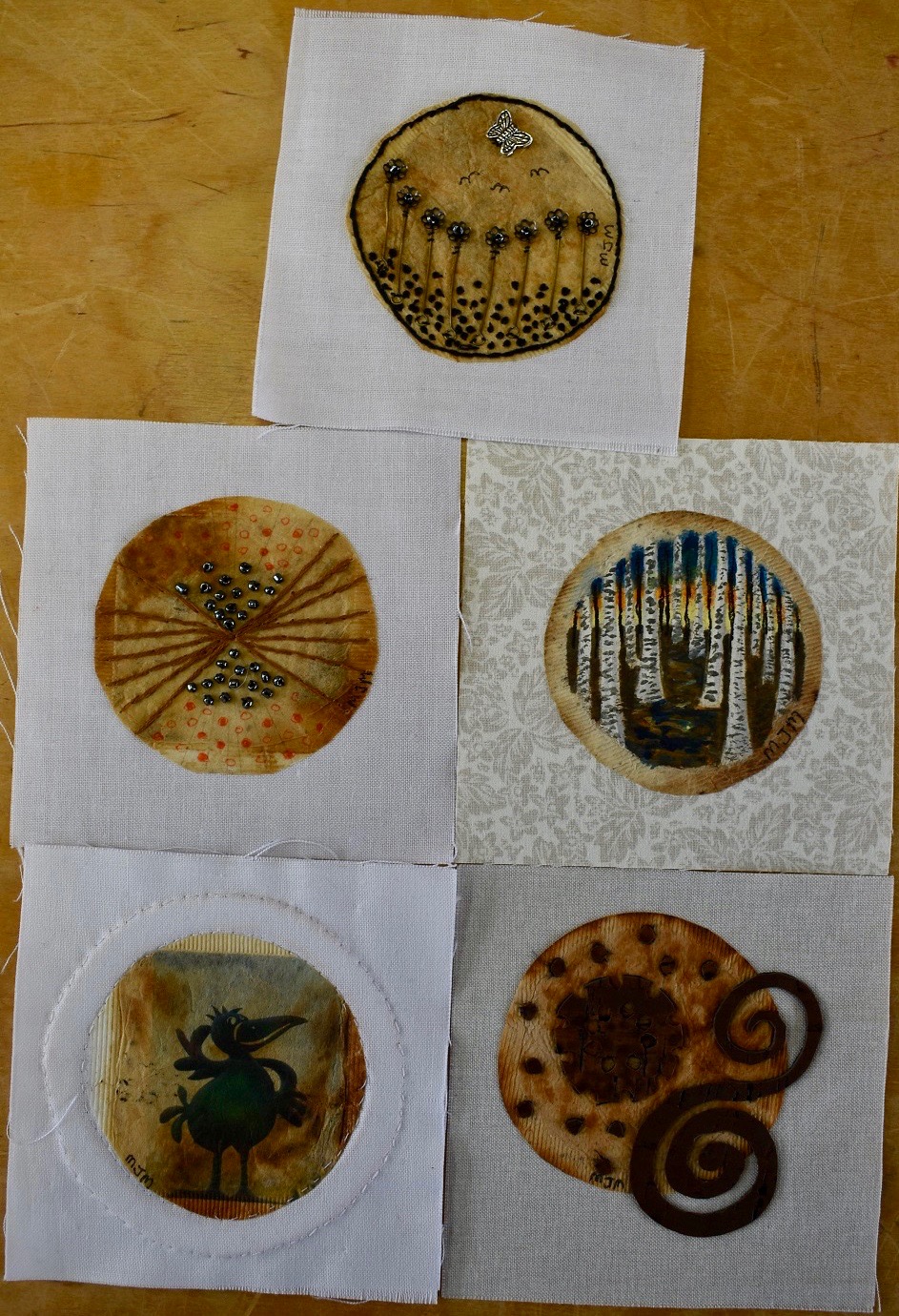
We had a varied Show and Tell this meeting.  Many different takes on the tea bags, some using last month's ideas and some not.

Those that tried the flour resist had lots of trouble removing it from the fabric.  Brigitte is trying a wheat starch paste instead and will have results and more information next month.

Both wheat starch and cornstarch are very fine, powdery substances use in baking.  They are primarily used as thickeners.  Potato Dextrin is a starch resist that can also produce lace like patterns and crackle lines.  Most often used as a resist in an overall area.  Available at Maiwa Supply or ask Cath to bring in the jar she has left over from previous dyeing.


The leaf is made with Fosshape.  Fosshape looks like a white pliable felt, but it is a unique non woven fabric comprised of low melt synthetic polyester fibre.  When heated with your steam iron it will melt and form to what ever shape you want.  It is used in the millinery trade and popular for costume making for Cosplay.

https://www.farthingalescorsetmakingsupplies.com/Wonderflex-and-Fosshape-s/1989.htm


Joltz

Betty had us folding and cutting paper to make lovely snowflakes, who knew it was still so much fun to see all the different results!


Presentation by Christine                          Sashiko

The striking hand sewing technique that originated in ancient Japan.  In Japanese, its name mans 'little stabs'  -  a reference to the plain running stitch the makes up sashimi's geometric, all over patterns.

Traditional sashiko combined decorative technique with mending and quilting.  It was a practical technique that helped farmers and fishermen stay warm and make the most of their families' resources.

Sashiko is considered a 'folk textile' because it was produced and used by the peasant classes.  Sashiko was winter work for women from farming or fishing families, who used the technique to extend the life of worn fabrics, mend, and winterize clothing and embellish everyday items.

Sashiko was a crucial part of a mending technique called boro.  Boro means 'tattered reeds' in Japanese. Boro textiles look like flour studies: multiple shades of indigo fabric are patched or quilted together neatly with sashiko stitches, covering holes and reinforcing worn areas.

Traditionally, sashiko patterns were sewn with off white stitches on dark indigo fabric,  These colours always seemed to be a classic combination, like whitecaps on the ocean or a dark blue mountain topped with snow.  In truth, sashiko's colours evolved from poverty and an oppressive class structure.

https://www.seamwork.com/issues/2016/04/sashiko
The Ultimate Sahiko Sourcebook by Susan Briscoe in available in the guild library.
 
Christine's sashiko tea bags


The online store 'Stitch in the Ditch', located in West Kelowna, has a good selection of sashiko supplies.  

Check them out here : 

https://www.stitchintheditch.com/Sashiko-Fabric-Supplies-s/1112.htm

Bernie is up next for Joltz.

We will be working on idea's for our central tea bag display for the quilt show next month.  Bring your ideas!  Brigitte will bring tea bags!

Monday, 18 March 2019

March Meeting

Betty is preparing to lead us next year so she was our chair for this month's meeting.

Joltz was prepared by Kay and we had a couple of interesting pages to ponder.  Can you name the familiar phrase from a picture?  Some were harder than we thought.

Brigitte talked about the 'Shelter' exhibit at Gallery Vertigo,  people are enjoying the works displayed by a diverse group of artists.  Some of us went over after lunch and were impressed by the variety of interpretations on the theme. The exhibit runs until March 30.

Betty suggests we look at the Fibre Art Network (FAN) website and the wonderful online exhibitions you can see there.  Check out the exhibit called 'Ekphrastic', poetry interpreted by the artist in a wide range of styles.
Their exhibition 'Conversations' is on display at the Kamloops Art Council Main Gallery and Hallway from Wednesday April 10 to Saturday May 4.       http://kamloopsarts.ca

Show and Share had more great tea bag art displayed.  We were catching up with most of us showing two months work.  The themes were 'Taking Liberties' and 'Mosaic".

Elisabeth


Kay


Cathy
Christine

Cath
Liz
Linda


 Both Sandi and Liz brought along the mostly finished displays of the pieces they are keeping.

 Sandi has a folded book with pockets for her tea bag cards.


Liz is making a larger piece to showcase her theme of 'Family'.


Presentation

Sandi and Liz talked to us about flour resists.  They had been wanting to try this for some time so did some experimenting and brought along the samples.

They played with different thickness of flour and water paste with very different results.  The paste was applied to fabric either in a piping bag and then sprayed with Dye-Na- Flow paint, or spread on the fabric and then left to dry.  After drying the paste was cracked into small pieces and the whole thing painted as well.  After that had dried the flour resist is removed and some great crackle textures are created.

A Google search of Flour Paste Resist will keep you busy for hours!


Crackle
    
Piping bag


Crackle with different paints
Flour spread on fabric


Friday, 15 February 2019

February meeting

The snowy weather kept our numbers low but we had a good time on our road trip to Lumby.  We visited the Village Gallery to see our Water pieces on display.  The Gallery host said our fibre art show has had a lot of attention, with viewers from Lake Country to Salmon Arm.

Joltz was the Scavenger Hunt. It was endearing to hear the stories that went along with the answers. 

Cathy’s ‘Dandelion Tea’ project is coming along beautifully.  The Tea bags in show and tell were inspiring as usual.   


Presentation on Mosaics by Brigitte.   The notes of that presentation follow. 

MOSAICS AS AN ART FORM

Form the floors of ancient Pompeii to the walls of the New York subway, mosaics have been a feature of urban life for thousands of years.

A mosaic is a piece of art or image made from the assembling of small pieces of colored glass, stone, or other materials.  It is often used in decorative art or as interior decoration.

Most mosaics are made of small, flat, roughly square pieces of stone or glass of different colours, known as tesserae.  Some, especially floor mosaics, are made of small rounded pieces of stone, and called "pebble mosaics".

Mosaics have a long history, starting in the 3rd millennium BC.  Mosaics with patterns and pictures became widespread in classical times, both in Ancient Greece and Ancient Rome.  Early Christian basilicas from the 4th century onward were decorated with wall and ceiling mosaics.  Mosaic art flourished in the Byzantine Empire from the 6th to 15th centuries.  Mosaic fell out of fashion in the Renaissance, though artists like Raphael continued to practice the old technique.  Roman and Byzantine influence led Jewish artists to decorate 5th and 6th century synagogues in the Middle East with floor mosaics.

Mosaic was widely used on religious buildings and palaces in early Islamic art, including Islam's first great religious building, the Dome of the Rock in Jerusalem.  Modern mosaics are made by professional artists, street artists, and today as a popular craft. Many materials other than traditional stone and ceramic tesserae may be employed, including shells, glass and beads. 

The earliest known examples of mosaics made of different materials were found at a temple building in Abra, Mesopotamia, and are dated to the second half of 3rd millennium BC. They consist of pieces of colored stones, shells and ivory.

Mythological subjects, or scenes of hunting or other pursuits of the wealthy, were popular as the centerpieces of a  larger geometric design, with strongly emphasized borders.

Greek figural mosaics could have been copied or adapted paintings, a far more prestigious art form, and the style was enthusiastically adopted by the Romans so that large floor mosaics enriched the floors of Roman dwellings. Most recorded names of Roman mosaic workers are Greek, suggesting they dominated high quality work across the empire; no doubt most ordinary craftsmen were slaves. Splendid mosaic floors are found in Roman villas across North Africa, in places such as Carthage, and can still be seen in the extensive collection in Bardo Museum in Tunis, Tunisia.

There were two main techniques in Greco-Roman mosaic: tiny tesserae, typically cubes of 4 millimeters or less, and was produced in relatively small panels which were transported to the site glued to some temporary support. The normal technique used larger tesserae, which were laid on site.

The mosaics of the Villa Romana del Casale near Piazza Armerina in Sicily are the largest collection of late Roman mosaics in situ in the world, and are protected as a UNESCO World Heritage Site. Built largely in the early 4th century, the mosaics were covered and protected for 700 years by a landslide that occurred in the 12th Century. The most important pieces are the Circus Scene, the 64m long Great Hunting Scene, the Little Hunt, the Labours of Hercules and the famous Bikini Girls, showing women undertaking a range of sporting activities in garments that resemble 20th Century bikinis.

https://en.wikipedia.org/wiki/Mosaic


Monday, 14 January 2019

January Meeting 2019


We started off our meeting with great news!  

Betty Klein has agreed to help Brigitte for the rest of this year and take over the leader role in September.  Thanks so much, Betty!

Kay is looking for suggestions for Art Quilting books for the VSSQ library and also let us know that the new Quilting Arts book is now in.


Our 'Fabric of Water' quilts are up in the Lumby Gallery and there is a road trip planned for the February meeting.  If you are thinking of going up another time Linda says she will be there on Wednesday afternoons.

Gallery Vertigo is still accepting submissions to the show 'Shelter'.  You have until February 5 to get your paperwork in.  Criteria and entry forms can be found at:    https://galleryvertigo.com

Joltz was a puzzle based on the works of Piet Mondrian.  It was harder than you would think!

We had a great Show and Share of Tea Bags.  Some were based on last month's presentation and a few were multiples as people caught up. 


Jeanette
Brigitte
Liz and Linda

Cath
Betty
Sandi and Elizabeth

  
Bernie and Kay


PRESENTATION

Betty's presentation was on Canadian Artists.  She called it 'Taking Liberties'.  That phrase will be your inspiration for next months tea bag.                                                                                                                                                      

Some of her examples were:  


Doris McCarthy, known for her abstract landscapes and icebergs. http://www.utsc.utoronto.ca/~dmg/

Robert Bateman, a very well known BC wildlife artist and teacher. http://robertbateman.ca/art/rbop/rbatemanonpainting.html

And no talk of Canadian artists is complete without mentioning the Group of Seven. http://www.arthistoryarchive.com/arthistory/canadian/The-Group-of-Seven.html

There is an excellent new book out on them, Defiant Spirits by Ross King.

Betty had done two tea bags with that phrase in mind.  Both with torn pieces of tea bag added to her background in a random fashion.


Cathy GB ended the meeting with a look at her first mock up of her personal tea bag piece.  She is still in the design phase and was looking for feedback on some issues she is facing.  She is working with the Principles of Design.  We certainly hope our input was helpful.


September, the start of a new year!

Welcome back to all returning and new members!    "Art enables us to find ourselves and lose ourselves at the same time." Thomas M...