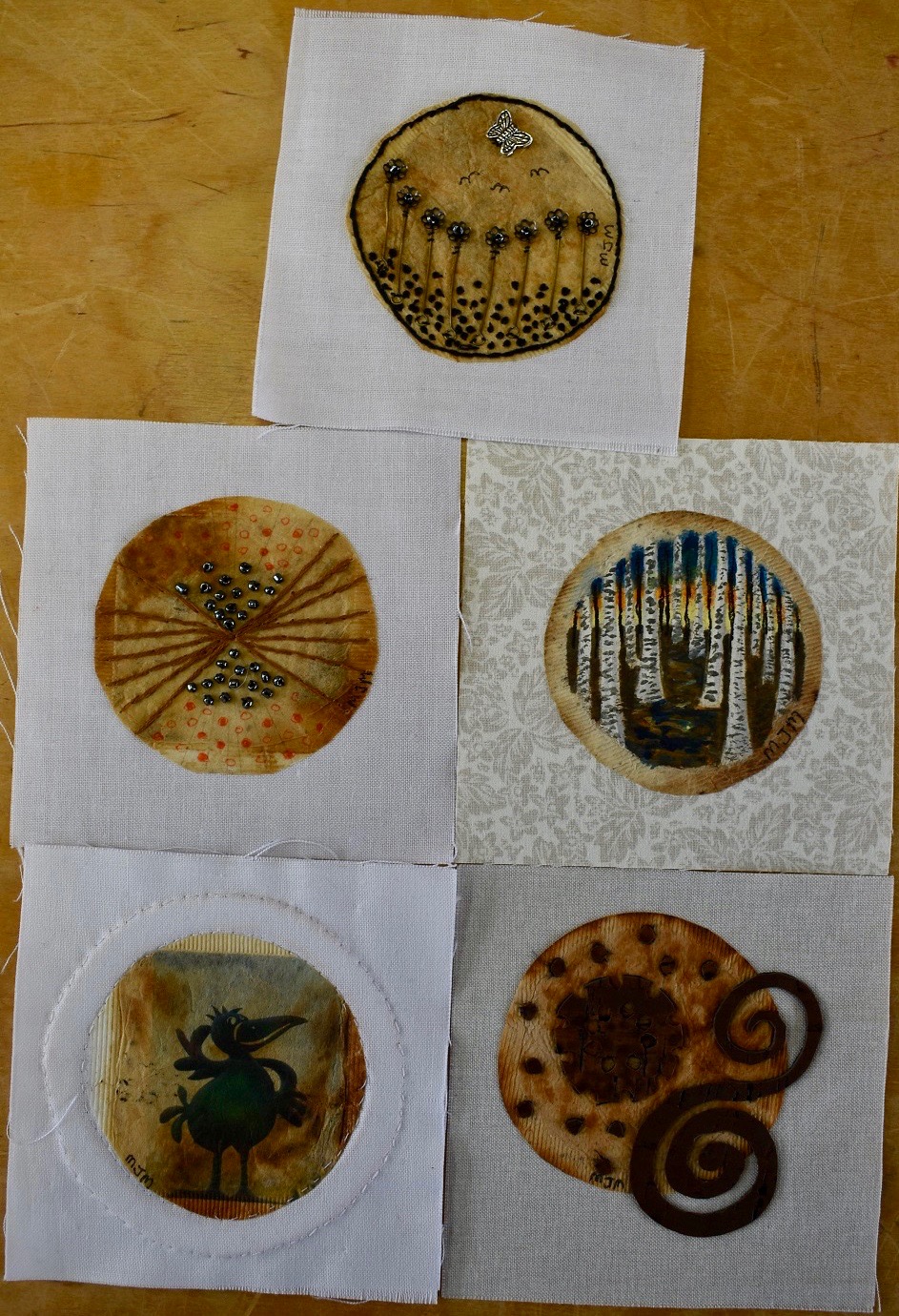
Friday, 15 February 2019

February meeting

The snowy weather kept our numbers low but we had a good time on our road trip to Lumby.  We visited the Village Gallery to see our Water pieces on display.  The Gallery host said our fibre art show has had a lot of attention, with viewers from Lake Country to Salmon Arm.

Joltz was the Scavenger Hunt. It was endearing to hear the stories that went along with the answers. 

Cathy’s ‘Dandelion Tea’ project is coming along beautifully.  The Tea bags in show and tell were inspiring as usual.   


Presentation on Mosaics by Brigitte.   The notes of that presentation follow. 

MOSAICS AS AN ART FORM

Form the floors of ancient Pompeii to the walls of the New York subway, mosaics have been a feature of urban life for thousands of years.

A mosaic is a piece of art or image made from the assembling of small pieces of colored glass, stone, or other materials.  It is often used in decorative art or as interior decoration.

Most mosaics are made of small, flat, roughly square pieces of stone or glass of different colours, known as tesserae.  Some, especially floor mosaics, are made of small rounded pieces of stone, and called "pebble mosaics".

Mosaics have a long history, starting in the 3rd millennium BC.  Mosaics with patterns and pictures became widespread in classical times, both in Ancient Greece and Ancient Rome.  Early Christian basilicas from the 4th century onward were decorated with wall and ceiling mosaics.  Mosaic art flourished in the Byzantine Empire from the 6th to 15th centuries.  Mosaic fell out of fashion in the Renaissance, though artists like Raphael continued to practice the old technique.  Roman and Byzantine influence led Jewish artists to decorate 5th and 6th century synagogues in the Middle East with floor mosaics.

Mosaic was widely used on religious buildings and palaces in early Islamic art, including Islam's first great religious building, the Dome of the Rock in Jerusalem.  Modern mosaics are made by professional artists, street artists, and today as a popular craft. Many materials other than traditional stone and ceramic tesserae may be employed, including shells, glass and beads. 

The earliest known examples of mosaics made of different materials were found at a temple building in Abra, Mesopotamia, and are dated to the second half of 3rd millennium BC. They consist of pieces of colored stones, shells and ivory.

Mythological subjects, or scenes of hunting or other pursuits of the wealthy, were popular as the centerpieces of a  larger geometric design, with strongly emphasized borders.

Greek figural mosaics could have been copied or adapted paintings, a far more prestigious art form, and the style was enthusiastically adopted by the Romans so that large floor mosaics enriched the floors of Roman dwellings. Most recorded names of Roman mosaic workers are Greek, suggesting they dominated high quality work across the empire; no doubt most ordinary craftsmen were slaves. Splendid mosaic floors are found in Roman villas across North Africa, in places such as Carthage, and can still be seen in the extensive collection in Bardo Museum in Tunis, Tunisia.

There were two main techniques in Greco-Roman mosaic: tiny tesserae, typically cubes of 4 millimeters or less, and was produced in relatively small panels which were transported to the site glued to some temporary support. The normal technique used larger tesserae, which were laid on site.

The mosaics of the Villa Romana del Casale near Piazza Armerina in Sicily are the largest collection of late Roman mosaics in situ in the world, and are protected as a UNESCO World Heritage Site. Built largely in the early 4th century, the mosaics were covered and protected for 700 years by a landslide that occurred in the 12th Century. The most important pieces are the Circus Scene, the 64m long Great Hunting Scene, the Little Hunt, the Labours of Hercules and the famous Bikini Girls, showing women undertaking a range of sporting activities in garments that resemble 20th Century bikinis.

https://en.wikipedia.org/wiki/Mosaic


Monday, 14 January 2019

January Meeting 2019


We started off our meeting with great news!  

Betty Klein has agreed to help Brigitte for the rest of this year and take over the leader role in September.  Thanks so much, Betty!

Kay is looking for suggestions for Art Quilting books for the VSSQ library and also let us know that the new Quilting Arts book is now in.


Our 'Fabric of Water' quilts are up in the Lumby Gallery and there is a road trip planned for the February meeting.  If you are thinking of going up another time Linda says she will be there on Wednesday afternoons.

Gallery Vertigo is still accepting submissions to the show 'Shelter'.  You have until February 5 to get your paperwork in.  Criteria and entry forms can be found at:    https://galleryvertigo.com

Joltz was a puzzle based on the works of Piet Mondrian.  It was harder than you would think!

We had a great Show and Share of Tea Bags.  Some were based on last month's presentation and a few were multiples as people caught up. 


Jeanette
Brigitte
Liz and Linda

Cath
Betty
Sandi and Elizabeth

  
Bernie and Kay


PRESENTATION

Betty's presentation was on Canadian Artists.  She called it 'Taking Liberties'.  That phrase will be your inspiration for next months tea bag.                                                                                                                                                      

Some of her examples were:  


Doris McCarthy, known for her abstract landscapes and icebergs. http://www.utsc.utoronto.ca/~dmg/

Robert Bateman, a very well known BC wildlife artist and teacher. http://robertbateman.ca/art/rbop/rbatemanonpainting.html

And no talk of Canadian artists is complete without mentioning the Group of Seven. http://www.arthistoryarchive.com/arthistory/canadian/The-Group-of-Seven.html

There is an excellent new book out on them, Defiant Spirits by Ross King.

Betty had done two tea bags with that phrase in mind.  Both with torn pieces of tea bag added to her background in a random fashion.


Cathy GB ended the meeting with a look at her first mock up of her personal tea bag piece.  She is still in the design phase and was looking for feedback on some issues she is facing.  She is working with the Principles of Design.  We certainly hope our input was helpful.


Sunday, 16 December 2018

December Meeting


We had a good turn out for the meeting in December despite holidays and some fresh snow on the ground.

For Joltz this month Cath brought along paper with a few blobs of water colour paint on it.  The idea was to turn this into faces.  Just a few lines with your pen.  The results were varied and amusing.

Joltz faces

Show and tell was up next and the tea bags keep coming in.  The creativity displayed is wonderful!

More faces.


Judith has done all of her tea bags for the group.  Her motif is tree.
She decided on a word play, can you guess all of them?
Hint - the middle one is Chemistry.


Catherine gave a very interesting presentation on the Native and Celtic Art styles. We had difficulty coming up with an accurate definition of this style of art.
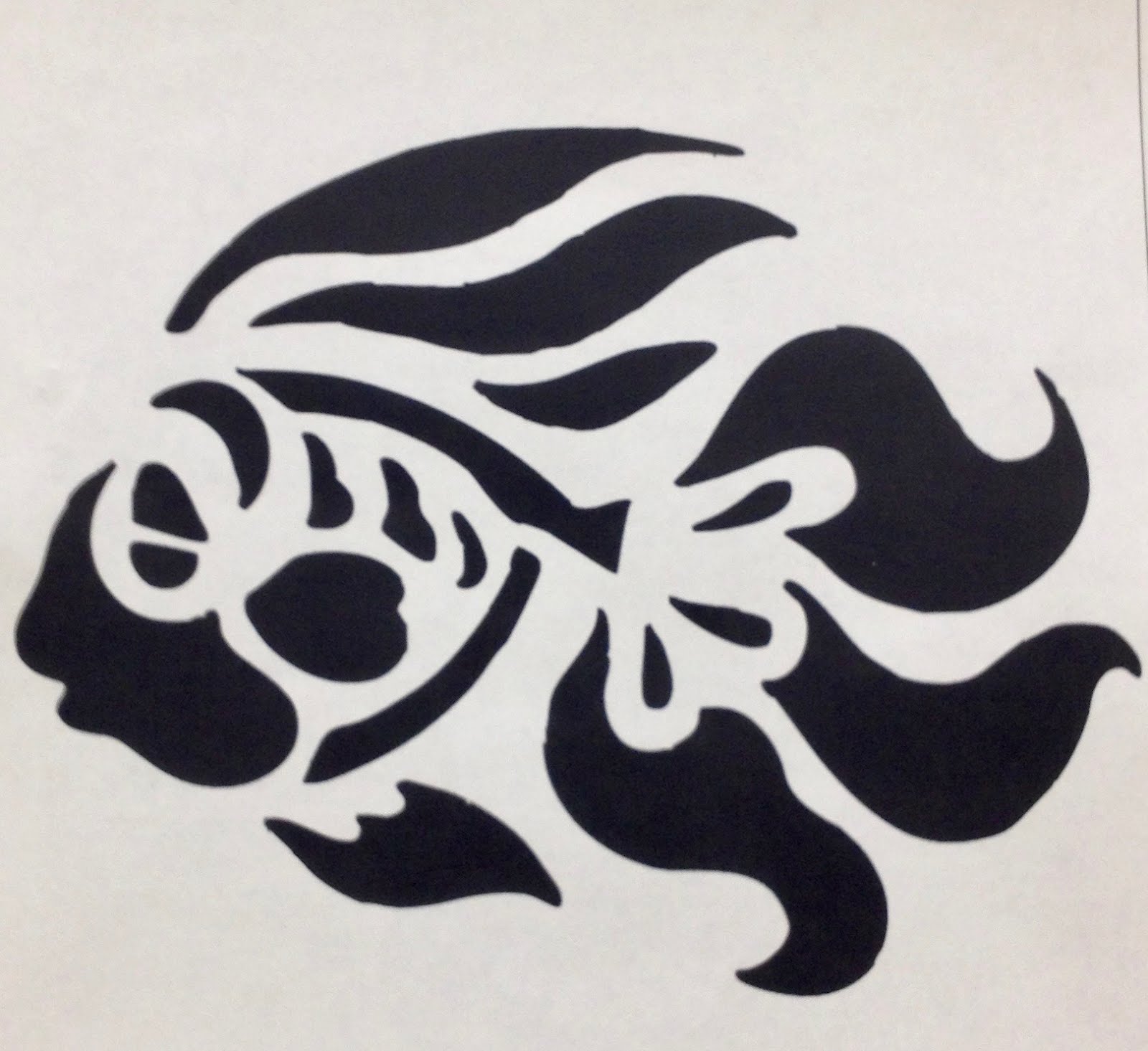
Native art is characterized by thick lines of colour in bold shapes that evoke an image. The style is representational rather than realistic and two-dimensional. Formline is a term sometimes used to describe Northwest Coastal design. The stylistic elements can be u-shaped, ovoids and s-shapes. The patterns depicted are usually animals, nature, and legendary creatures such as thunderbirds.


Celtic art is often extremely stylized. Energetic circular forms and spirals are characteristic. Typically Celtic art is ornamental, avoiding straight lines and only occasionally using symmetry. Celtic art has used a variety of styles and shown influences from other cultures in their knot work, spirals, key patterns and lettering. There is a sense of balance in the layout and development of patterns, the filled areas and spaces form a harmonious whole.


Stensils use similar lines, again representational not realistic.  


Stensil 


Stensil art


These art styles are often found in modern tattoo designs.


Celtic inspired tattoo art


Sunday, 18 November 2018

November Meeting

JOLTZ started off our November meeting.   Very simple instructions, starting with 'Draw an I.'  Or is it an EYE?  Draw a T.  What would you choose to draw?  No two turned out the same.

The tea bag show and tell was amazing!  Everyone has their own interpretation of the art form and the results are as beautiful as they are varied.


Presentation                   Bernie

Bernie's presentation was on using our computers to print images on the tea bags and then colour them.

He used free clip art or copyright free images found online.  They were then reduced in size to fit on a tea bag.  In his word program he arranged them on the paper and printed that out.  He then taped the tea bags down over top of the image and ran it through the printer again to print the image directly on the tea bag.  This method works with both laser and ink jet printers.

As the tea bag is delicate I found that fusing it to a larger  piece of thin fabric before taping it to the paper worked well and made it easier to remove the tape.   Tracing the image on to the tea bag is another option.

Bernie then coloured the images in with water colour pencil and carefully brushed water over to enhance the colours and smooth out the pencil lines.

There were pre printed tea bag samples for us to colour and you know how we like to colour!

One more interesting way to do your tea bags.


A Google search of Tea Bag Art will supply endless choices for you.

Here are a few websites that will inspire:

http://alysnsburntofferings.blogspot.com/2015/10/large-balls-and-fun-with-tea-bags.html?m=1

http://www.rubysilvious.com

https://www.curbly.com/9932-10-marvelous-examples-of-tea-bag-art

Catherine will be doing the December presentation.


August

 We were back at our usual location this month and the wildfire smoke is letting up a little more.  Our thoughts are with everyone who is ex...